The idea
Understanding takes its own time.
Some ideas click immediately. Others need another explanation, a worked example, or a second attempt. Kunang gives Malaysian primary-school children a place to work through those moments at their own pace.
The product brings Bahasa Melayu, English, Mathematics, and Science into one learning space for SK Years 1–6. Parents can follow recorded progress while children return to the lessons and questions that need more practice.
The experience
Read. Try. Understand. Return.
The learning journey connects explanations and worked examples with practice, quizzes, and feedback. Saved progress lets a learner pick up where they left off. Subject tests provide another way to check understanding beyond an individual lesson.
Parents create a family and manage child profiles. Children enter their own learning sessions without needing a personal email account. The public website explains the experience before registration, and a free UASA self-check offers a starting point without signing in.
The engineering
One family. Separate learning spaces.
Parent controls and child learning sessions serve different purposes. The application checks family relationships and permissions on the server, keeping each child's progress attached to the right profile. Returning to adult controls requires an adult unlock.
PostgreSQL stores learning attempts and progress. Assessment grading runs on the server, with versioned content and submission handling that avoids counting the same attempt twice. The React and TypeScript application runs on Cloudflare, with Neon supporting the database and authentication.
The design
Curiosity, with room to breathe.
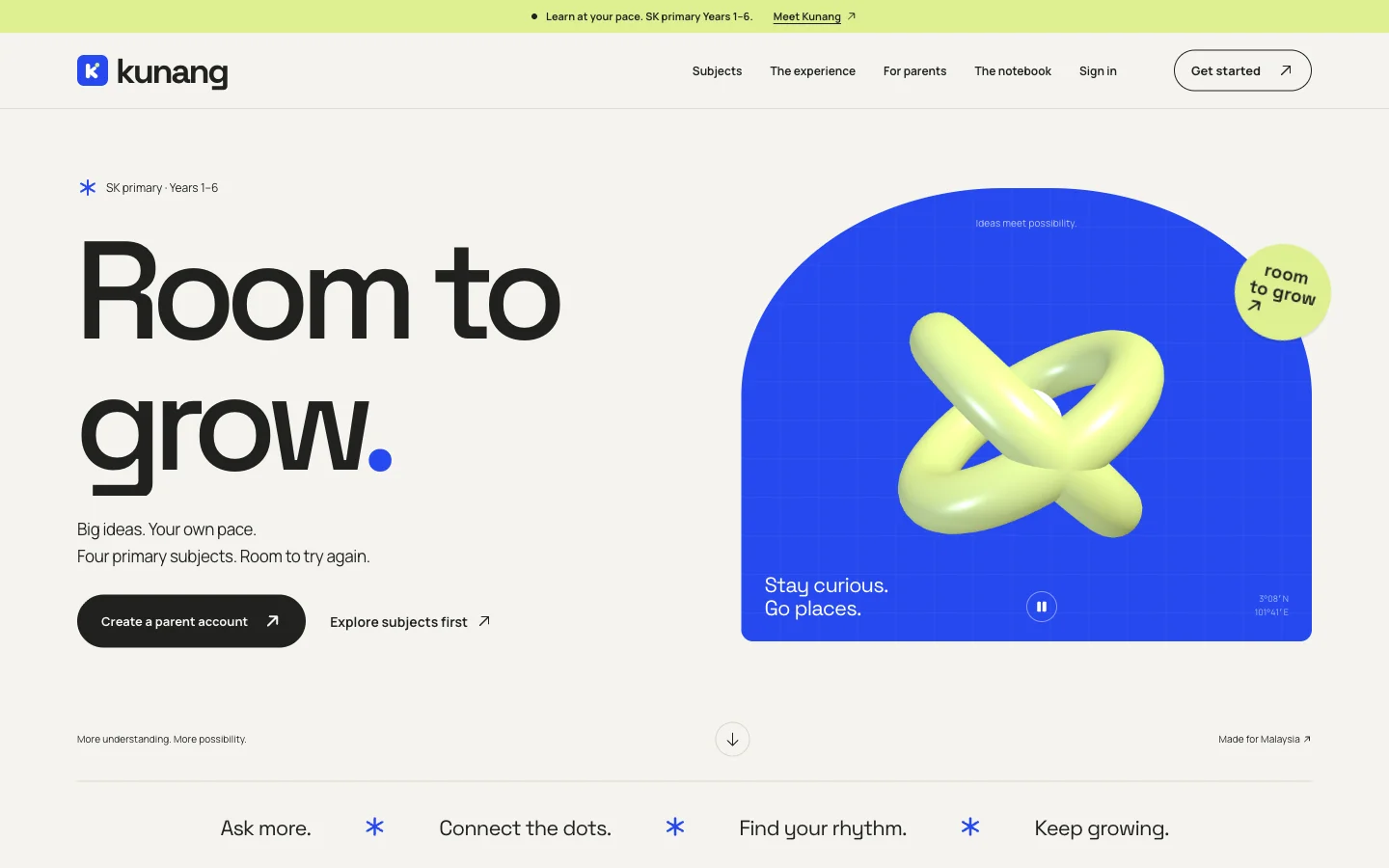
Large typography, cobalt blue, lime accents, and playful geometry give the public site a clear identity. GSAP motion and Three.js artwork add movement while the learning content remains the focus.
The case study shows the public product rather than private family accounts. Its scope is self-paced learning: live tuition is a future phase. Digital quiz results support practice and parent conversations; they are not a claim of official school assessment or accreditation.